
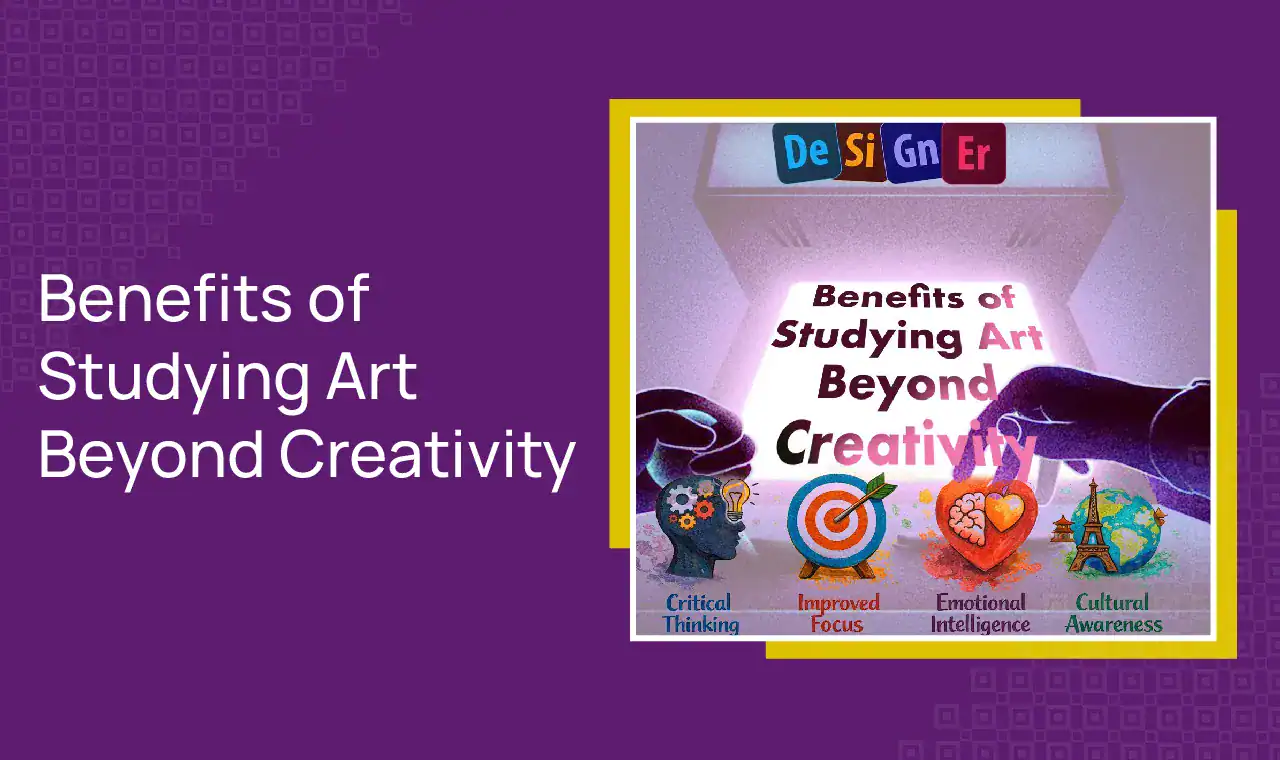
Art has always been connected to creativity and self-expression, though its worth is much deeper than drawing or painting. Understanding the benefits of art education properly means looking past what students produce and focusing on what the process builds in them – critical thinking, emotional intelligence, and a deeper ability to see and interpret the world around them. How art education improves creativity is well documented, but the benefits of art education beyond creativity are what make it genuinely essential – for children, for school students, and for adults at every stage of learning.
Structured art education is increasingly becoming popular among children, students, and even adults who wish to develop powerful creative backgrounds today.
Art, either as a hobby or profession, is very influential in how we think, learn, and communicate. The importance of art education for students becomes clearest when you look at what they carry forward – not just the ability to draw, but the ability to observe, communicate, and solve problems with confidence. When one realises the wider rewards of studying art, one will find the reasons why art is always significant in every age and life stage.
Boost your child’s creative and academic growth today.
A] Why Is Art Important in Education?
The answer begins with what happens inside the learner. The importance of art in education is that art helps in cognitive and emotional growth. Art also teaches students to be able to think on their own, test their ideas, and solve problems in different ways. Art also teaches flexibility and adaptability, unlike other subjects, where the answer is fixed.
Students can learn patience, focus, and discipline through drawing, painting, or sculpting. Art also enhances emotional sensitivity in that it enables people to communicate thoughts and feelings that might not be easily articulated. Why art is important for students’ academic growth is partly answered here – the discipline and observation skills built in art sessions transfer directly into how students approach every other subject on their timetable. Art helps promote whole-person learning in a classroom by balancing analytical subjects with creativity. Such an amalgamation assists students to be more holistic thinkers instead of dwelling on rote memory alone.
B] Benefits of Studying Art
The benefits of studying art for students continue in the real world, even among those who have no intention of becoming creators. Art is a way of sharpening the eyesight of people to observe the detail, pattern, and connection that others may not. This competency is directly related to problem-solving and decision-making.
Confidence is also developed in studying art. Creating an artwork, which is finished upon completion, creates a sense of success and self-confidence. Furthermore, art provides a good release of emotions, which decreases stress and enhances mental health. What are the benefits of art therapy for students? In structured art education, students regularly experience exactly this – the calming effect of focused creative work that reduces anxiety and builds emotional resilience. Such advantages render art worthwhile not only in academics but also in personal and professional life.
Is art a good career choice for students in India? The answer begins here – with a foundation built through consistent, structured art education that develops the visual thinking and creative confidence that creative careers reward.
C] Importance of Art and Craft in Early Learning
The importance of art and craft for children is particularly noticeable in the kindergarten years. Drawing, colouring, cutting, and modelling clay, among others, build hand-eye coordination and fine motor skills. Such preliminary skills help in writing, reading, and other study skills in the future. The benefits of drawing for children’s brain development are well established – regular drawing practice strengthens spatial reasoning, visual memory, and concentration in ways that carry forward into academic performance.
Art and craft for early childhood development works precisely because young children are natural visual thinkers before they become verbal ones. Imagination and storytelling are also fanned by art and craft. Children learn how to express ideas visually and create narratives around their work when they create images or objects. This reinforces creativity as well as promotes independent thinking.
The benefits of art for kids in Mumbai extend beyond the classroom – particularly in a city where children’s schedules are often packed with academic preparation. A regular art class for children in Mumbai gives young learners a structured space to build creative confidence, fine motor ability, and observational skills in a way that no other subject delivers. Awareness of art at an early age fosters curiosity and confidence, which preconditions lifelong learning.
D] Why Study Art in School?
Visual literacy, communication, and creative problem-solving are skills that are enhanced in art education and are appreciated across industries.
Does studying art help with other subjects? Consistently, yes. Students who engage with structured art education at the school level tend to develop stronger observational habits, more patient problem-solving approaches, and a greater ability to communicate ideas visually – skills that support science, geography, history, and even mathematics. Exposure to art at the school level also exposes students to various creative disciplines, including fine art, design, animation, and visual communication.
School art education is also where students first encounter the kind of board-level examination that matters for their future – the ICSE Art Optional Paper is one such route, giving ICSE students a practical, skill-building subject that simultaneously strengthens the visual foundations needed for design career pathways. This is an early expedition that allows students to find out their interests before making any specialised path in the future. Art has been shown to enhance innovation and versatility, even in students who are taking science or commerce, and thus it is a strong additive to conventional studies.
E] Learning Art as a Beginner
To a beginner, the task of learning art may seem daunting, but it does not need to be so. How to start learning art for beginners always follows the same sequence – shapes before details, proportion before shading, observation before imagination. Many beginners start learning how to draw step-by-step, not with perfection, but with shapes, proportions, shading, and observing.
Beginner art education tips consistently point to one thing above all else: consistency over talent. It matters far less how naturally you draw on day one than how regularly you practice in the first three months. For anyone looking to learn to draw from scratch in Mumbai, the right environment makes a significant difference – a studio setting with patient instruction and individual feedback accelerates the learning curve in a way that self-study alone rarely does.
Art classes for beginners in Mumbai typically cover sketching, colour perception, and composition – the foundational principles that give every subsequent skill somewhere to grow from. These well-organised spaces enable learners to gain confidence slowly. The initial basic knowledge will enable students to acquire a solid visual background, and then proceed to more sophisticated methods or specialised styles.
Consistency is more important than talent – whether you learn art by yourself or with guided support. For those starting out with no prior experience, our hobby art classes for beginners in Mumbai offer a relaxed, beginner-friendly entry point into structured art learning.
F] Career Opportunities After Studying Art
Career opportunities after studying art in India are wider than most students and parents realise. Art education leads to a variety of creative and professional possibilities. Students taking fine art courses with a career focus in Mumbai can follow paths in painting, sculpture, illustration, or teaching. Some move into applied arts like graphic design, fashion design, animation, interior design, or visual merchandising.
Is art a good career choice for students in India? The employment data says yes – and increasingly so. Design, media, advertising, film, gaming, and UX/UI design are all industries with active hiring and growing salary benchmarks. Competitive creative careers are built upon art education.
Numerous careers demand strong portfolios and entrance exam preparation. In their choice of field, students tend to develop their artistic abilities with formal preparation – including UCEED exam preparation or NIFT entrance exam preparation. These tests are rich in creativity, observation, and design thinking, all of which are directly built through art training.
Students who want to explore their career options can also enrol in fine art courses in Mumbai – a direct pathway into both academic and applied creative careers. For those unsure of direction, a design career counselling session helps map art skills to the right career path before committing to a course.
G] Art Education & Competitive Design Exams
An excellent art base is essential to those students who aspire to join design institutes. Art education for NID and NIFT entrance exams is not just about drawing practice – it is about building the design thinking, visual reasoning, and observational depth that these highly competitive national exams test. Art education and competitive design exams in India are more closely connected than many students realise when they begin preparation.
Art as a foundation for design college in India works because the skills built through structured art education – observation, proportion, colour sense, compositional thinking – are precisely the skills that NID, NIFT, UCEED, MAH-AAC-CET, and the Elementary Grade Drawing Exam assess. Students cannot shortcut this foundation with exam coaching alone; the visual vocabulary must be built first.
Students who intend to study design can integrate art with their studies by taking art and design courses in Mumbai, where they are exposed to a variety of creative disciplines. Design courses after art education build directly on this foundation – many of our students move from general art classes into specialised programmes in product design, communication design, fashion, and UI/UX design.
Students preparing for the Elementary & Intermediate Grade Drawing Exam or the MAH-AAC-CET BFA entrance exam will find that structured art education at UAF directly maps to what these exams test – timed drawing, observational skills, and design aptitude. Learning art develops the visual vocabulary and self-esteem needed to excel in competitive exams as well as in design studios.
To see what structured art education has led to for our students – exam results, college placements, and creative achievements – explore UAF student achievers and results.
Join Mumbai’s trusted art classes now.
Conclusion
Art is not just a creative hobby, but it is an effective life skill that promotes learning, emotional maturation, and professional development. The benefits of art education are visible from early childhood through to professional life – from the fine motor development of a kindergarten student to the design thinking of a graduate walking into a studio. From an early age to adulthood, the study of art enhances observation, communication, and problem-solving skills.
The importance of art education for students is not limited to those who choose art as a career – it is relevant to every student who wants to think more clearly, communicate more effectively, and approach problems with genuine creativity. Art education prepares a solid foundation for long-term development, whether one follows it as a way of personal enhancement or as a career. Through systematic learning and regular practice, art will not only be a reservoir of creativity but also a bridge to various opportunities.

Komal Ullal
Ms. Komal Ullal, a recipient of the prestigious President’s Award and Co-founder of UAF, is an expert in student profiling, enhancing artistic skills, mentoring in design thinking and an inspiring women entrepreneur. With an impressive collection of 577 awards—including 196 trophies and 109 medals—earned in drawing and painting at both national and international levels, she was featured in the Limca Book of Records in 2007 as the youngest achiever of such accolades. Her passion and dedication continue to inspire budding artists and designers worldwide.