
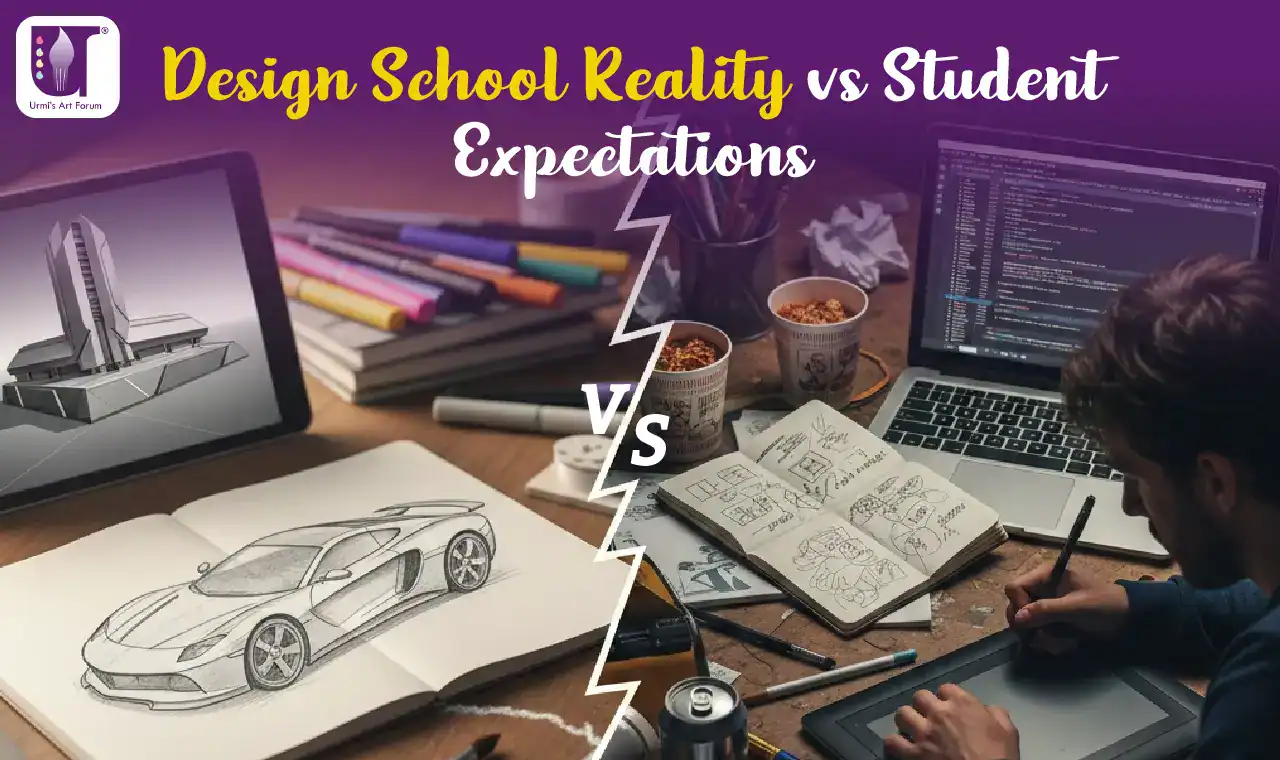
In the past ten years, there has been a tremendous increase in interest in design education in India. As the careers in digital media continue to be more numerous, the innovation of products, branding, animation, and user experience, an increasing number of students are finding the world of design a career worth considering. The emergence of the creative industry has seen design professions as transparent, perceived as prestigious, and economically viable like never before.
Nevertheless, the level of enthusiasm is high, and clarity is low in many cases. Social media, brief workshops, or even just passing by art have conditioned many students who enter into design school with a bunch of assumptions. Professional design programs may prove to be different from the reality that they envisioned. This discrepancy between what is anticipated and the academic requirements usually turns out to be the greatest problem within the first year in college.
This difference can be understood early to enable students to prepare better and make informed career choices.
Confused About Design as a Career?
A] What Students Commonly Expect
1. A Focus on Pure Creative Design
Most students think of design school as a place where they go, endlessly sketching, generating ideas, playing with colors, and working on projects. To most people, creative designing seems like making a job out of a hobby. They demand liberation, laxity, and self-expression without strict frontiers.
Since they have possibly visited unofficial workshops or a weekend course in design art, they expect college to be like that, easy and exploration-oriented. Creativity is a central issue in design and is but a small component of a far bigger system.
2. Minimal Theory and Academic Pressure
Another common belief is that design courses are less demanding than traditional academic streams. Since they do not follow conventional exam-heavy formats, students assume there will be less theory and reduced stress.
In reality, design education involves structured learning in areas such as user psychology, ergonomics, sustainability, materials, and research methods. The foundation of design thinking and education lies in structured problem-solving frameworks that require both analytical and creative abilities.
Students preparing for entrance exams quickly discover this complexity. Proper uceed preparation demands logical reasoning, visualization skills, observation, and time-bound performance. Those seeking structured guidance often explore UCEED coaching in Mumbai to understand the real level of competition and preparation required.
B] What Design Colleges Actually Expect
1. Discipline and Time Management
Professional design institutes expect students to treat creativity like a serious discipline. Institutes such as the National Institute of Design, IDC School of Design, and MIT Institute of Design maintain rigorous studio schedules and demanding project timelines.
Assignments often run simultaneously across subjects. Students may spend long hours refining prototypes, preparing presentations, or revising concepts based on feedback. Exploring expectations at leading institutions listed among the top design schools in India helps students understand that commitment and consistency are non-negotiable.
2. Balance Between Creativity and Technical Skills
Colleges expect students to combine imagination with execution. Strong ideas must be supported by technical precision, research, and clear communication.
Developing solid design skills involves learning drawing fundamentals, digital tools, model-making techniques, typography, and presentation methods. Creativity without structure rarely succeeds in professional environments.
Regular critiques are part of the system. Students present their work to faculty and peers, receive detailed feedback, and are expected to improve continuously. This process strengthens resilience and sharpens thinking.
C] Academic and Practical Demands
1. Studio Culture and Deadlines
Unlike school classrooms, design programs revolve around studio spaces. These collaborative environments encourage discussion, experimentation, and iteration. However, they also demand accountability.
Deadlines are strict. Evaluations are continuous rather than limited to final exams. Students are graded on research quality, concept clarity, execution, and documentation of their process.
Students who begin training early through structured art classes in Mumbai often adapt more comfortably to this disciplined environment because they are already familiar with consistent practice routines.
2. Research and Idea Development
Many new students are surprised by how much emphasis is placed on research before designing anything. Design is about solving problems, not decorating surfaces.
Understanding user needs, studying context, and exploring alternatives form the backbone of innovation and design thinking. Without research, ideas remain superficial.
Strong conceptual growth depends heavily on structured idea development in art. Learning systematic approaches through resources like idea development in art can significantly improve a student’s ability to translate raw thoughts into refined solutions.
D] Skill Gaps New Students Face
1. Foundation and Technical Gaps
Many students enter design college confident in their creativity, but struggle with fundamentals. Weak observation drawing, limited exposure to digital tools, and a lack of visual storytelling skills often become obstacles.
This is where structured art foundation courses prove valuable. They build essential skills such as proportion, perspective, shading, composition, and visual analysis, all crucial for professional training.
Students also need to identify and correct common mistakes in art early in their journey. Recognizing areas of improvement through guidance, such as insights shared in mistakes in art, accelerates progress.
2. Communication and Collaboration
Design is not very often a solitary affair. Students should be able to express their ideas in a straightforward manner, collaborate, and respond to criticism.
Constant feedback is emotionally difficult to adapt to, which applies to many people. Professional growth is learning to separate personal identity and creative output. Teamwork enhances vision and opens the students to new ways of solving problems.
E] Bridging the Gap Successfully
1. Preparing Before Enrolment
Students need to do their research on the programs prior to making a decision on the specialization in design they want to undertake. Which design course is best does not depend on popularity, but rather on what fits the needs in terms of personal strengths and long-term objectives.
Prospective students should:
- Practice daily sketching
- Develop observation skills.
- Acquire time management skills.
- Study design case studies
- Seek mentorship
Early exposure reduces shock during the first year and builds confidence.
2. Building Mental Readiness
Design education is challenging yet very fulfilling. Learners should be ready in mind to spend long hours in the studio, revision, and sharp criticism.
Learning under structured environments, communicating with professionals, and comprehending reality are useful in making assumptions and reality congruent. The greater the information that a student has prior to enrolment, the easier the process.
Start Your Structured Design Preparation Today
Conclusion
Design school is not mere art education in the form of hobbies. It is a professional process that is very demanding and requires creativity and discipline, research, technical expertise, and endurance.
The difference between expectation and reality usually contributes to the aspect of students being overwhelmed or empowered. Knowing the real needs of the design courses, enhancing the initial skills, and getting psychologically ready will enable future designers to enter the world of studies with confidence.
Designing is not a step that is made based on glamorous assumptions. Students will be able to open the doors of their creative future when they match their expectations with the realities of professional training.

Komal Ullal
Ms. Komal Ullal, a recipient of the prestigious President’s Award and Co-founder of UAF, is an expert in student profiling, enhancing artistic skills, mentoring in design thinking and an inspiring women entrepreneur. With an impressive collection of 577 awards—including 196 trophies and 109 medals—earned in drawing and painting at both national and international levels, she was featured in the Limca Book of Records in 2007 as the youngest achiever of such accolades. Her passion and dedication continue to inspire budding artists and designers worldwide.