
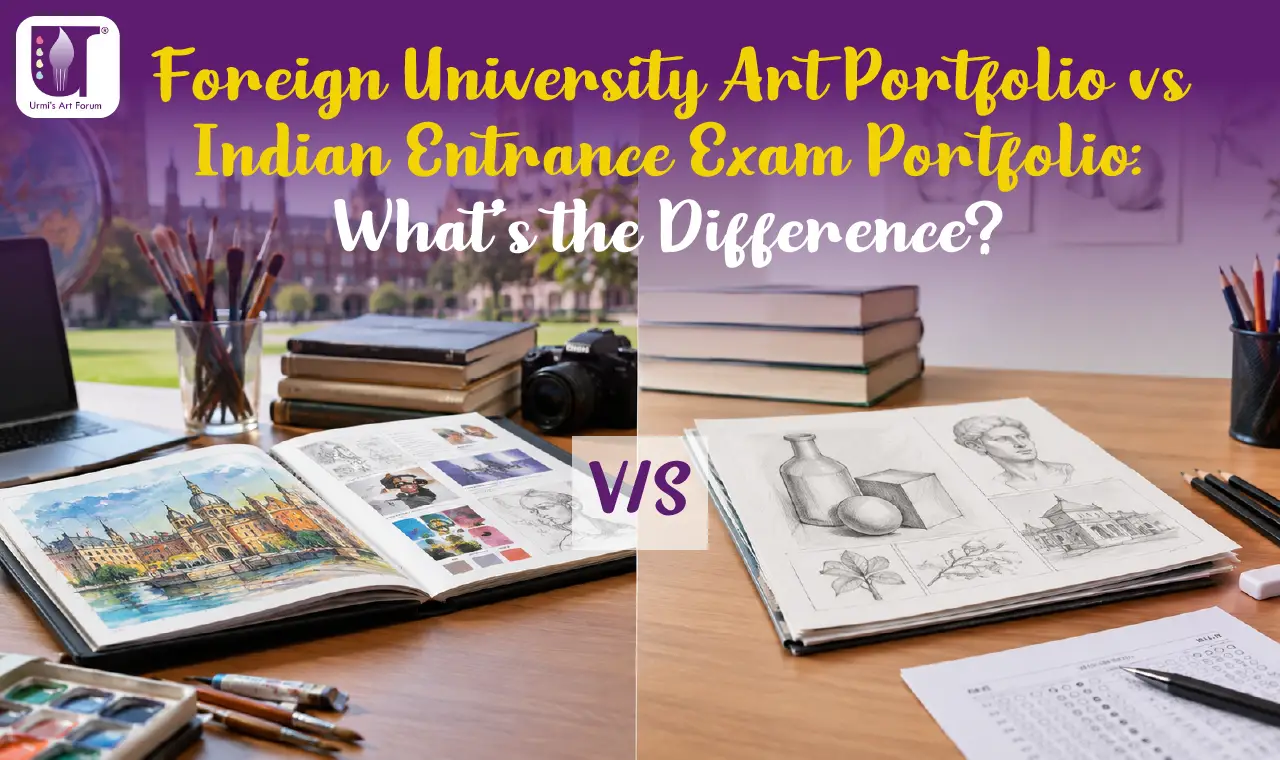
When students apply to art and design schools, they may assume that the same portfolio approach will work for every application. But what foreign universities and Indian entrance exams generally assess is different. A foreign university portfolio typically focuses on creative identity, development, experimentation, and ideas. Entrance work, however, is intended to show drawing skills, observation, creativity, visual problem-solving and preparation for an examination.
What Foreign Universities Look for in a Portfolio
Foreign universities have a few expectations when reviewing a portfolio. Foreign art and design schools are interested not only in your creative work but also in your way of thinking and evolving as a creative person. Your portfolio should not only show technical skill but also your interests, curiosity and creativity.
If you’re unsure about “how to make an art portfolio for design school“, the first step is to know what the course and university will ask for.
For those who wish to apply overseas, art portfolio coaching for the US, UK, Singapore & Europe can assist in understanding the expectations for the portfolio in different countries and courses.
Personal Voice & Originality
As long as it feels personal, a strong international portfolio will do. The subjects, media, methods and visual vocabulary should express your point of view, not just those that are widely used on the internet.
Process & Experimentation
Don’t only exhibit finished work. Add sketches, experiments, material tests, iterations, research, and failed attempts, if applicable. These can help show the evolution of your thoughts and your openness to other options.
Concept & Storytelling
Good projects typically convey an idea or point of view. Whatever you are researching, whether that’s identity, fashion, architecture, society, or just life, your portfolio needs to demonstrate the link between your research, thinking, and visual results.
It is important to keep in mind that there may be different portfolio expectations at different universities and courses for students preparing a design portfolio for Parsons, RISD, and UAL. Before you decide on work to include, research the requirements.
Build the right portfolio for your design school application with expert guidance
What Indian Entrance Exams Look for
Indian design entrance exams focus on skills that can be demonstrated during the examination. Preparation typically involves observation, drawing, creativity, visualisation and problem-solving. Exams such as NID DAT, NIFT and UCEED assess these abilities through their respective selection processes, while CEED is relevant for students applying to postgraduate design programmes.
The skills developed through entrance exam preparation can also support portfolio development, but the two require different approaches. Entrance preparation focuses on building the skills needed for the selection process, while portfolio development involves selecting and presenting work according to the requirements of the target university and course.
Students can enhance their preparation with NID entrance exam coaching or NIFT entrance exam coaching in Mumbai (for those who are based in Mumbai).
Observation & Drawing Skills
In observational drawing, students must grasp the concepts of proportion, perspective, form, scale, objects, people, and environments. The emphasis is on conveying an idea in a clear way, not on creating a very polished illustration.
Creativity & Visual Problem-Solving
Entrance questions may ask students to be creative with the prompt they are given. You might need to visualise an idea, make a composition, interpret a situation or come up with a solution in a hurry.
Speed & Exam Readiness
One of the important factors in entrance tests is time. Students learn to work efficiently and remain clear and creative with regular timed sketching, mock tests, visualisation and prompt practice.
The Biggest Difference Between the Two
The difference is that, for the first, it is a job, while for the second, it is a hobby. A foreign university portfolio is a reflection of your creative identity, development, experimentation, and ideas. Entrance-focused preparation: observation, drawing, creativity, visual reasoning, problem-solving, and speed.
International portfolios are typically well edited and are presented as a story, whereas preparation for the entrance emphasises skills that are more likely to be shown within a time limit.
If you know what is required for your portfolio to gain admission to NIFT or its equivalent for the route you are applying for, you can plan better and not create a portfolio based on the wrong criteria.
Common Mistakes Students Make
Here are some of the most frequent errors to avoid:
- Copying artwork: Do not copy artwork from Pinterest, Instagram or other online platforms. Admissions staff are looking for your own thoughts and creative approach.
- Only present completed work: Add sketches, experiments, iterations, and research to demonstrate how your ideas progressed.
- Not following course requirements: Each university and course will have their own submission requirements. Make sure to verify your target institution’s expectations.
- The same approach, all the time: The purpose and priorities of an entrance-focused submission and an international university portfolio may differ.
- Not documenting your process: One of the best art portfolio tips for students is to document experiments, reflect on your decisions, and choose work that illustrates creativity and development.
If You’re Applying to Both
Students who wish to apply for both Indian and foreign universities can make preparations without causing any kind of confusion. Urmi’s Art Forum’s practical art and design classes can help students build a foundation in sketching, creativity, experimentation and visual development while they work towards their specific application requirements.
Concurrently, develop skills specific to entering the picture, including observation drawing, perspective, visualisation, composition and timed problem-solving. Selected projects may be overlapping, but the final presentation should be customised to the application.
A portfolio counselling session can be useful if you are not sure what to include in a design portfolio and can help you to identify where there are gaps and how your current portfolio can be enhanced.
Students pursuing the IB curriculum may also seek coaching in IB Visual Arts to enhance their research, experimentation and portfolio development.
Explore our art and design courses and find the right fit for your goals
Conclusion
They are not the same; they are different questions. A foreign university is interested in your creative identity, ideas and potential, and an entrance exam is designed to assess your ability to observe, think visually, solve problems, and respond under constraints. This distinction will enable students to strategically prepare and develop the appropriate portfolio for each application.
If students are comparing an art portfolio for design school in India to overseas applications, the focus shouldn’t be on making the choice between the two. Rather, create a flexible foundation of creativity and apply it to the institution to which you’re applying. If you’re unsure about which skills to prioritise or how to prepare for different application routes, you can contact us to discuss your portfolio and preparation needs.
FAQs
1. Can I use the same portfolio for both NID/NIFT and a foreign university like Parsons or UAL?
You can reuse selected projects, but tailor the final submission to each institution’s requirements.
2. How many pieces should be in a portfolio for a foreign art school?
There is no universal number. Follow the course guidelines and prioritise quality over quantity.
3. Does clearing NID or NIFT help my chances of getting into a foreign design school?
It can show design experience, but foreign universities assess applications using their own criteria.
4. What is an artist statement, and do Indian exam portfolios need one?
An artist statement explains your ideas and creative approach. Whether you need one depends on the application.
5. I’m in Class 11 or 12—when should I start building my portfolio?
Starting in Class 11 gives you time to explore, experiment, document your process, and improve without rushing.

Komal Ullal
Ms. Komal Ullal, a recipient of the prestigious President’s Award and Co-founder of UAF, is an expert in student profiling, enhancing artistic skills, mentoring in design thinking and an inspiring women entrepreneur. With an impressive collection of 577 awards—including 196 trophies and 109 medals—earned in drawing and painting at both national and international levels, she was featured in the Limca Book of Records in 2007 as the youngest achiever of such accolades. Her passion and dedication continue to inspire budding artists and designers worldwide.