
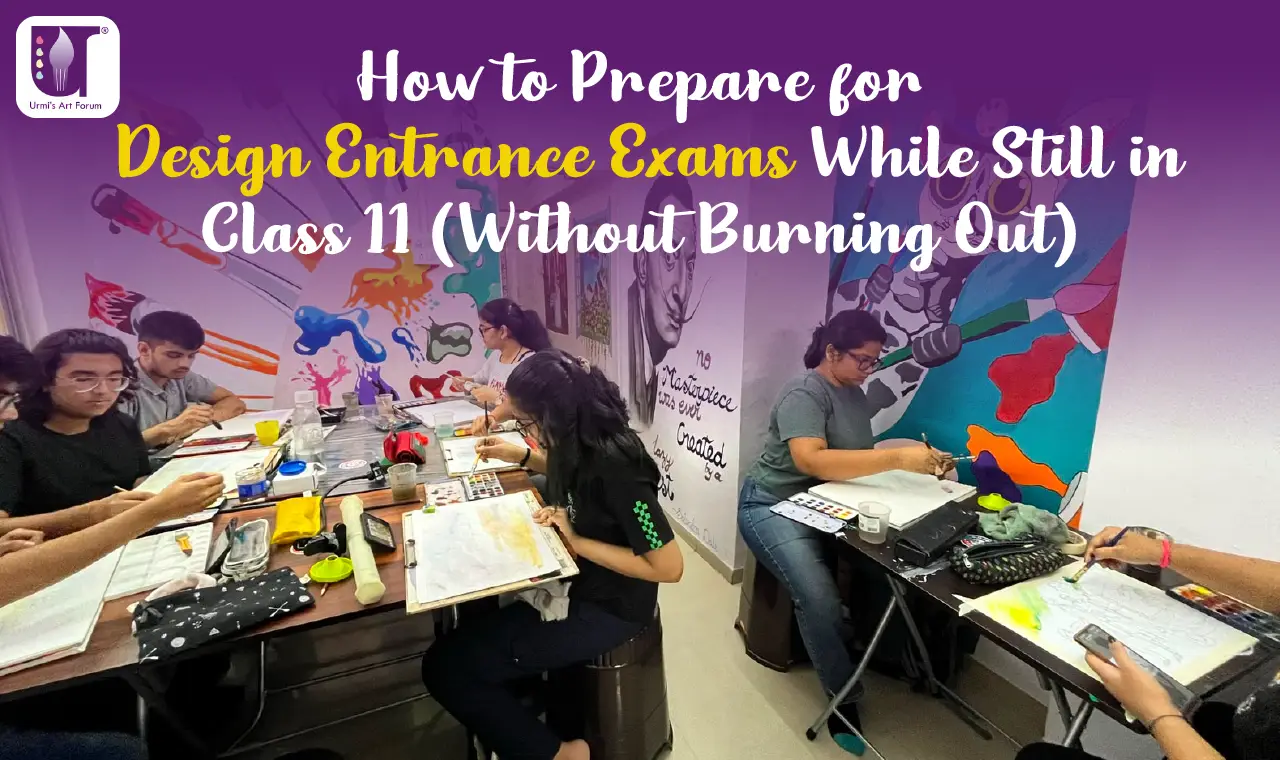
Class 11 is a great time to start planning for creative careers and competitive design admission. Students who are interested in design frequently ask what the entrance exam requirements are for the creative sphere of study and how to prepare for them in advance. From the point of view of creative and aptitude development, it is always better to start early, whether one is preparing for NID, NIFT, UCEED, or BFA admission.
But it is often difficult to find time to study, coach, and practise their drawings. In this guide, you’ll learn how to prepare for the design entrance exam without burning out while enhancing your creativity, observation, and confidence over time.
A] Why Starting in Class 11 Gives an Advantage
Students have ample time to develop their drawing, observation, and analytical skills naturally if they begin preparing in Class 11. The preparation for one of the top design entrance exams in India does not just involve theory; it also involves the development of creativity and visual understanding systematically.
Students facing any kind of design entrance test get more confident with sketching and aptitude questions before the Board pressure starts in Class 12. It also enables the students to grasp the concept of what design aptitude is through gradual practice rather than last-minute preparation.
B] Exams Students Can Prepare for in Class 11
Students from Class 11 can start preparing for various design entrance and creative exams, including:
- NID DAT
- NIFT Entrance Exam
- UCEED
- CEED Foundation Preparation
- BFA entrance exams
Each design examination has different criteria for creativity, observation, logical thinking, and aptitude, so preparation early on is beneficial to help understand what they are good at. You must also keep yourself abreast of the latest exam pattern of the upcoming design entrance exams and also know the syllabus requirements of the exams.
C] How to Balance School and Design Preparation
A major challenge is juggling schoolwork with entrance exam preparation. It is best to plan week-by-week rather than making an unrealistic daily plan.
Students are to split study time into smaller blocks for the following:
- School academics
- Aptitude preparation
- Sketching practice
- Observation exercises
- Revision
Studying for extended periods is not as productive as studying in short periods, which breaks up the monotony and lowers stress. If you are confused about where to start aptitude preparation, you should start with basic reasoning and observation questions gradually.
A flexible routine can also help to avoid fatigue in preparing for any common entrance examination for design.
Feeling overwhelmed balancing Class 11 and entrance exam prep?
Urmi’s Art Forum (UAF) helps you prepare with a smart, stress-free learning plan.
D] Daily Creative Exercises Students Should Practice
It is expected that creative practice will be an integral part of the daily life of the student from Class 11 onwards. The following exercises may be completed regularly as part of class:
- Object sketching
- Perspective drawing
- Visual memory exercises
- Doodling
- Design observation
Sketching objects regularly helps to develop observation skills and hand control, and perspective drawing helps to develop the concepts of depth and proportion. Visual memory exercises develop a rapid recall of details, helpful in numerous entrance tests.
This activity enhances creativity and students’ insight into the reality of any design entrance test preparation, naturally, over time.
E] Importance of Sketchbooks & Observation Skills
One of the best tools for the design aspirant is a sketchbook, which can aid in the enhancement of ideation, imagination, and visual thinking. Students will need to have a sketchbook regularly for notes to document the following:
- Quick sketches
- Textures and patterns
- Daily observations
- Creative concepts
- Design inspirations
The observation habits will also assist in the design of the entrance exam syllabus areas of visualisation and creativity.
F] Common Burnout Mistakes Students Make
Students often feel compelled to overschedule themselves with coaching, schoolwork, and too many hours of practice. Typically, the following mistakes occur when a person experiences burnout:
- Making constant comparisons to others
- Unrealistic Study Plans
- Excessive screen time
- Not taking breaks or sleeping when necessary
- Practising without consistency
Reliance on comparison to other students can be counterproductive in terms of low self-esteem and unnecessary anxiety. The other major issue is that students are too dependent on tutorials and have not learned from them since they spend so much time watching them.
Any student preparing for any common entrance examination for design should know that consistency is more effective than studying for very long hours of studying.
G] Healthy Study Routine for Long-Term Consistency
A healthy study routine is crucial to being creative and concentrating. Pupils are to be encouraged to develop a focus on:
- Proper sleep schedules
- Regular screen breaks
- Free time and leisure activities
- Realistic study targets
- A healthy lifestyle and reading habits
Students preparing for a design entrance exam should focus on cultivating sustainable habits rather than relying on fleeting motivation. Entrance preparation is a process that is gradual and requires patience and practice.
H] When to Start Mock Tests & Portfolio Preparation
Once the students have acquired basic skills, aptitude, and sketching, they can start light practice for a mock test in Class 11 during the second half of the class. Preparing well for the entrance exams becomes more critical in early Class 12.
The preparation of the portfolio should start gradually by saving the following:
- Strong sketches
- Creative projects
- Observation work
- Design exercises
- Personal concepts
Regular practice of the old year papers is also important for students taking up upcoming design entrance exams to get an idea of the trend of the questions and boost their confidence.
Want to crack design entrance exams without burnout?
Join Urmi’s Art Forum (UAF) for expert guidance that fits your Class 11 schedule.
Conclusion
Students are given sufficient time to build their creativity, aptitude, and confidence on a gradual basis by preparing for design entrances from the 11th Standard. Instead of following stressful routines, they should focus on consistent practice and gradual skill development.
Whether you are looking for NIFT entrance exam coaching or UCEED entrance exam coaching, Urmi’s Art Forum offers art and design classes with expert guidance. Contact us today to begin your preparation.
FAQs
1. Is Class 11 the right time to start design entrance preparation?
Indeed, it is one of the best times to start preparing for Class 11, as students have sufficient time to get used to developing their creativity, aptitude, observation, sketching, etc., in a gradual manner without putting them under undue stress.
2. How can I balance school studies and design entrance exam preparation?
Follow a flexible weekly schedule that includes schoolwork, sketching, aptitude practice, and revision. Short, consistent study sessions are more effective than long hours of study.
3. Which design entrance exams can students prepare for in Class 11?
Students can start preparing for exams such as NID DAT, NIFT Entrance Exam, UCEED, and BFA entrance exams while also building a strong foundation for future design entrance tests.
4. How many hours should I study daily for design entrance exams?
There is no fixed number of hours, but 1–2 hours of focused practice alongside school studies is generally sufficient in Class 11. Consistency is more important than studying for long hours.
5. How can students avoid burnout during entrance preparation?
Students can avoid burnout by maintaining a realistic study routine, taking regular breaks, getting enough sleep, and focusing on consistent progress instead of comparing themselves with others.

Komal Ullal
Ms. Komal Ullal, a recipient of the prestigious President’s Award and Co-founder of UAF, is an expert in student profiling, enhancing artistic skills, mentoring in design thinking and an inspiring women entrepreneur. With an impressive collection of 577 awards—including 196 trophies and 109 medals—earned in drawing and painting at both national and international levels, she was featured in the Limca Book of Records in 2007 as the youngest achiever of such accolades. Her passion and dedication continue to inspire budding artists and designers worldwide.